music.wikisort.org - Composition
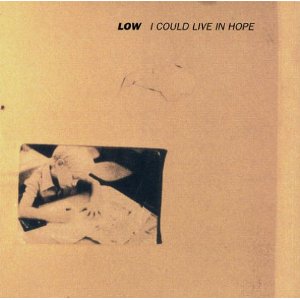
I Could Live in Hope is the debut studio album by American indie rock band Low. It was released on December 2, 1994, on Vernon Yard Recordings.
| I Could Live in Hope | ||||
|---|---|---|---|---|
 | ||||
| Studio album by Low | ||||
| Released | December 2, 1994 | |||
| Recorded | Autumn 1994 | |||
| Studio | Noise New Jersey, Hope Township, New Jersey[1] | |||
| Genre |
| |||
| Length | 57:05 | |||
| Label | Vernon Yard | |||
| Producer | Mark Kramer | |||
| Low chronology | ||||
| ||||
Background and composition
A reaction to the abrasiveness of alternative rock in the early 1990s, when grunge had reigning popularity, Low "eschewed conventional songwriting in favour of mood and movement."[2][3] Influenced by Brian Eno and Joy Division, the band, working with long-time producer and New York underground mainstay Mark Kramer, favored slow-paced compositions, a minimum of instrumentation and an economy of language.[4][3][5][6]
Reception
| Review scores | |
|---|---|
| Source | Rating |
| AllMusic |   [4] [4] |
| Chicago Tribune |  [7] [7] |
| NME | 7/10[8] |
| Q | [9] |
I Could Live in Hope received generally positive reviews from contemporary music critics. Writing for the Chicago Tribune, Greg Kot felt that "its heavy-lidded drama creeps by in all-enveloping slow motion" and called it "the best record made for those dreary, nothing's-going-on-and-I-want-to-crawl-into-a-hole afternoons since Galaxie 500's debut."[7]
Legacy
Featuring an "unprecedent pace in the then-flowering underground,"[3] I Could Live in Hope helped to birth the genre known as slowcore, which encompassed acts from Bedhead to Codeine throughout the 1990s.[5]
Pitchfork placed I Could Live in Hope at number 49 on its 1999 list of the best albums of the 1990s.[10] The same year, critic Ned Raggett ranked it at number 37 on his list of "The Top 136 or So Albums of the Nineties" for Freaky Trigger.[11] In 2004, the album was included in Les Inrockuptibles' "50 Years of Rock'n'Roll" list.[12] In 2018, Pitchfork placed it at number 22 on its list of the 30 best dream pop albums.[13]
Track listing
All tracks are written by Alan Sparhawk, Mimi Parker and John Nichols, except where noted.
| No. | Title | Lead vocals | Length |
|---|---|---|---|
| 1. | "Words" | Sparhawk | 5:45 |
| 2. | "Fear" | Sparhawk | 2:12 |
| 3. | "Cut" | Sparhawk | 5:43 |
| 4. | "Slide" | Parker | 3:46 |
| 5. | "Lazy" | Sparhawk | 5:35 |
| 6. | "Lullaby" | Parker | 9:46 |
| 7. | "Sea" | Sparhawk, Parker | 1:45 |
| 8. | "Down" | Sparhawk | 7:24 |
| 9. | "Drag" | Sparhawk | 5:11 |
| 10. | "Rope" | Sparhawk | 6:11 |
| 11. | "Sunshine" (Oliver Hood) | Sparhawk, Parker | 2:59 |
Personnel
Credits adapted from the liner notes of I Could Live in Hope.[14]
- Low
- Alan Sparhawk – guitar, vocals
- Mimi Parker – percussion, vocals
- John Nichols – bass
- Additional personnel
- Mark Kramer – production
- Steve Watson – assistant production
- Low – artwork
- Gerree Small – inner sleeve photography
References
- Low Live at KJHK-FM on 1994-05-02, Interview (part 2), Archive.org. Accessed March 15, 2020.
- Buckley, Peter (October 30, 2003). The Rough Guide to Rock. Rough Guides. p. 615. ISBN 978-1843531050.
- Earles, Andrew (October 9, 2014). Gimme Indie Rock: 500 Essential American Underground Rock Albums 1981-1996. Voyageur Press. pp. 177–178. ISBN 978-0760346488.
- Taylor, Ken. "I Could Live in Hope – Low". AllMusic. Retrieved August 19, 2009.
- Everhart, John (June 5, 2013). "Low Albums From Worst To Best". Stereogum. Retrieved February 18, 2016.
- Sprague, David (April 1, 1995). "Vernon Yard/Virgin Is Counting on Low's 'Long-Division'". Billboard. Nielsen Business Media. p. 14. ISSN 0006-2510. Retrieved February 18, 2016.
- Kot, Greg (February 24, 1994). "Low: I Could Live in Hope (Vernon Yard)". Chicago Tribune. Retrieved November 2, 2017.
- "Low: I Could Live in Hope". NME. September 3, 1994. p. 52.
- "Low: I Could Live in Hope". Q. No. 96. September 1994. p. 102.
- "Top 100 Albums of the '90s". Pitchfork. p. 6. Archived from the original on February 25, 2003. Retrieved July 28, 2019.
- Raggett, Ned. "The Top 136 Or So Albums Of The Nineties". Freaky Trigger. Archived from the original on January 20, 2000. Retrieved September 28, 2011.
- "I Could Live in Hope". Acclaimed Music. Retrieved February 14, 2016.
- "The 30 Best Dream Pop Albums". Pitchfork. April 16, 2018. p. 1. Retrieved April 24, 2018.
- Low (1994). I Could Live in Hope (Media notes). Vernon Yard Recordings.
| Authority control |
|
|---|

 | This 1990s indie rock album-related article is a stub. You can help Wikipedia by expanding it. |
Другой контент может иметь иную лицензию. Перед использованием материалов сайта WikiSort.org внимательно изучите правила лицензирования конкретных элементов наполнения сайта.
WikiSort.org - проект по пересортировке и дополнению контента Википедии